The Film Casino That Looks Like a Map
Learn how a film casino uses camera angles, set design and edits to suggest a coherent venue, and read what its layout reveals about the story.
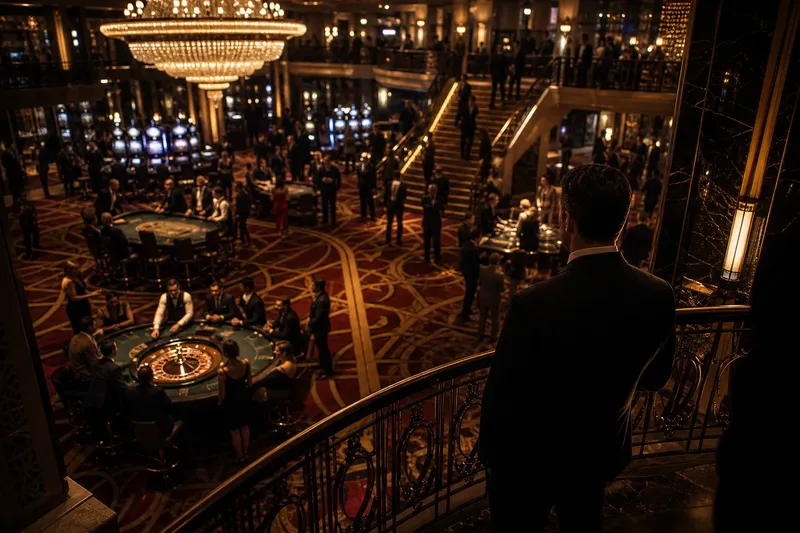
Why does a film casino look easy to cross in one scene, then seem to change shape when the camera turns? A film casino is designed around what the audience sees: its rooms can be assembled to make a story feel coherent without forming a usable floor plan.
That gap is especially revealing in a place whose visual language carries so much meaning. A chandelier, a bright gaming table or a guarded doorway can suggest glamour, risk or privilege before a character speaks. The casino’s architecture on screen is not just background; it helps tell the audience who belongs, who is watched and what kind of encounter is possible.
A film casino makes the frame feel like a place
A working venue must accommodate people, staff and practical routes. A film set must accommodate actors, cameras, lights and the needs of a scene. Those demands can produce a room that feels convincing from one angle while offering no sensible route beyond the edges of the shot.
Think of a shop window: its display is arranged for the view from the pavement, not to explain how the stockroom is organised. A casino set can work in the same way. The visible space carries the mood and action; the unseen parts may be altered or absent.
This does not make the setting meaningless or simply false. Its furnishings, colours and social rituals can evoke recognisable ideas about casinos. But a feeling of place is different from knowledge of its layout. One tells us what the venue is meant to mean; the other would tell a visitor how to get from one room to another.
Editing makes separate spaces feel connected
When a character enters, crosses a gaming floor and reaches a table, the edit can preserve the impression of one continuous journey. Direction of movement, matching details and the order of shots help viewers follow the action without stopping to reconsider the building.
The entrance, gaming floor and table might have been filmed in separate sets or locations. A corridor between them may never appear. If the sequence gives the audience enough cues to follow the story, the missing architecture does not interrupt the scene.
Recurring objects help establish a shared identity. A patterned carpet or distinctive light fitting can signal that two shots belong to the same imagined venue. It is a recognition cue, not reliable evidence of distance or direction.
Camera angles make the casino feel grand or intimate
A wide shot can present the casino as a destination full of movement and spectacle. A close shot can turn the same setting into a private arena for a tense conversation. By choosing what fills the frame, the camera tells viewers which details matter now.
Framing also hides information. Exits, service areas, other patrons and the edge of a set may all fall outside the image. A character can seem surrounded by a vast room when the camera sees only a shallow section of it.
Lighting guides attention in a similar way. A bright table against a dim floor can make a game feel like the centre of the world, while leaving the rest of the room difficult to read. The scene guides the viewer’s eye, not their feet.
Decor and staging define who belongs
On-screen design can make a casino seem welcoming, exclusive, threatening or theatrical. A polished table and attentive staff may suggest ceremony. Dense signs, crowded walkways and competing lights may suggest confusion or temptation. These are choices about representation, not neutral descriptions of architecture.
Consider whose experience the scene gives priority. Does the camera treat patrons as individuals, or as a moving crowd? Are staff shown as people with their own presence, or as part of the decor? Is the casino a place for shared ritual, private competition or anonymous spectacle?
Those choices shape the venue’s imagined culture. A character who feels at ease may read an open floor as an invitation. Someone under pressure may experience the same openness as exposure, with nowhere to hide.
What can a film casino layout tell you?
Does a continuous scene prove that rooms connect?
No. Editing can join images made in separate spaces, and a set may include only the parts required for the scene. Continuity shows how the story wants the action to flow, not a complete route through the building.
Why do repeated landmarks feel like directions?
Signs and distinctive furnishings help viewers recognise a setting across cuts. They can establish that a scene remains in the same casino without showing where one feature sits in relation to another.
Can an inconsistent layout still feel convincing?
Yes. The setting can feel credible within the story if its visual details and social behaviour work together. That impression does not make it a dependable architectural record.
What should you notice when the camera changes angle?
Watch which people and details receive attention, and which disappear from view. A change may clarify the action or create a stronger image without showing more of the room.
Read the casino as a designed point of view
Say a character leaves a bright gaming floor and appears at a quiet bar. The film shows the same carpet in both shots but no passage between them. The carpet links the spaces in the audience’s mind; the cut moves the character where the story needs them. The result is a clear transition, not proof of a route.
For a closer reading, use the scene itself as your evidence and make a decision about what each cue supports:
- Check a recurring landmark. If the same sign or light fitting appears in two shots, treat it as evidence of visual continuity; if its position changes, allow for a framing or set choice rather than plotting a route.
- Check the character’s movement. If the camera shows an entrance and an exit in one sequence, follow the visible path; if travel is omitted, treat the connection as unstated and avoid filling it in as fact.
- Check the frame edges. If an exit or window is visible, note how it relates to the action; if the edges conceal them, decide that the scene offers mood or action rather than orientation.
- Check changes in scale. If a wide shot establishes surrounding activity, read it as a view of the larger setting; if a close shot removes that context, do not assume the room itself has changed.
- Check the lighting and sound. If they draw attention to a table or performer, read that as a cue about emphasis; if they obscure other areas, leave those areas’ layout unresolved.
- Check who the camera follows. If it stays with one patron, read the casino through that character’s experience; if it shows staff and other patrons too, consider the broader social roles the scene assigns them.
Imagine a scene that opens on a wide view of a gaming floor, follows a patron past a red pillar, then cuts to a bar where the same pillar appears behind the counter. First, note that the wide view establishes a busy casino but does not show the bar’s location. Next, record the patron’s visible movement: the cut skips the journey, so the route remains unknown. Then compare the pillar: its repeated appearance links the shots, but its changed position could be a set or camera choice. The resulting reading is that the film presents one casino and a transition between activities, while leaving the floor plan unresolved.
A believable casino need not be mappable
Viewers accept spatial gaps because a scene has other priorities: a performance, a reaction, a reveal or a striking composition. A doorway that shifts between shots may matter less than the exchange taking place beside it. The film’s promise is usually emotional and narrative coherence, not architectural accuracy.
So when a film casino appears to offer a map, ask what the frame actually establishes. The search phrase film casino layout points to a useful distinction: recurring landmarks and continuous movement can make a venue feel connected, while the camera still withholds enough detail to prevent reconstruction. That limit can itself be meaningful; it shows which parts of the casino the story wants you to see, and whose experience it leaves outside the frame.